mardi 5 octobre 2010

The ServiceMag 3 is out

http://newtimes.co.rw/index.php?issue=14401&article=34178

ServiceMag 3 launched

By Linda Mbabazi
Email Articleexport articlePrint Article
image

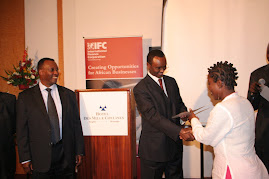
(L-R) The CEO of RDB, John Gara and Sandra Idossou unveil the third issue of the ServiceMag. (All photos by Malik Shaffy)

IF Sandra Idossou ever tires of being a consultant she should consider becoming an event organiser.

On Thursday night, Sept 30, Idossou, now a household name in customer service, launched her third issue of the ServiceMag in a classy cocktail event held at Manor Hotel, in Nyarutarama.

The function was well-attended and attracted various personalities from corporate companies and many others from the business sector.

In the magazine, Idossou describes Rwanda as a dynamic country in which so much is happening. There is much mention of the Common Market Protocol; since July 1, 2010, Rwanda together with Kenya, Uganda, Tanzania and Burundi have embarked on this Protocol that will bring about free movement of labour, capital, goods and services within region.

The focus of the new issue is the East African Community Common Market Protocol, and the main purpose of the launch was to bring together people in the service industry to discuss their challenges, share best practices and of course network.

The 57-page magazine covers a cross section of topics from business to entertainment; published in English, French and Kinyarwanda.

It is generally agreed that customer service in this country has been moving at a snail’s pace. A quick conversation with Idossou would give you some basic tips on how to treat a client at your place of work.

Of course, it is through training that people get to know the importance of treating customers with integrity and hospitality. Thereafter, people would always want to come to you for more services.

Maybe her name has become famous due to her reputed work ethics. Idossou’s efforts to educate the public on good customer service have created a positive impact in the country’s growing business sector.

Dressed in a black outfit, Idossou spotted a mix of modern and traditional hairstyle with dreadlocks, giving you a sense of rich, traditional culture that imbues her personality.
Her charming smile says it all. Additionally, Idossou speaks with a sense of confidence that endows her with a huge presence.

Despite the sophistication about her and the stardom on the customer service platform, Idossou can also be described as a simple lady.

Ends

dimanche 26 septembre 2010

IS CORPORATE SOCIAL RESPONSIBILITY MANDATORY?

IS CORPORATE SOCIAL RESPONSIBILITY MANDATORY FOR COMPANIES


READ THE FOLLOWING LINK


Is Corporate Social Responsibility Mandatory for Companies?

Email Articleexport articlePrint Article

Companies are often recognised as a group of different agents that have a relationship with shareholders, suppliers, citizens, competitors, customers and the community as a whole. Even though companies are created primarily to make profit, they are also required to be an integral part of the development of the community.

While meeting a potential sponsor of the next issue of The ServiceMag, we had a very interesting debate on this issue of corporate social responsibility. Though we found this person’s arguments relevant; we needed him to understand the concept of the magazine as an educational tool in developing the business community here in Rwanda.

At this point, I must acknowledge that our arguments paid off as the new issue of the magazine will be out on Wednesday September 30th 2010.

The World Business Council for Sustainable Development (WBCSD) defines Corporate Social Responsibility (also known as CSR) as “the commitment of the company to contribute to the sustained economic development by working with employees, their families, the local community and the entire society in order to improve life quality”.

This definition simply indicates that companies are also responsible for the social, economic, cultural and even political aspects of our community. It is no secret that the values of a good company go beyond its staff or customers’ satisfaction but also to a large extent on its contribution towards the development of the entire community.

In Rwanda, we see certain organizations here and there making donations to orphans once in a while. Can we describe this as part of corporate social responsibility? Yes…. Is this enough?

Maybe, maybe not.
We discussed this issue with some friends and they think that the frequent donations (most at times simple commodities such as sugar, oil, foodstuff etc) are rather a way for many companies to offer themselves some free publicity through the media.

Examples were given of companies that organise for television coverage while they are at Umuganda (mandatory communal work activities undertaken every last Saturday of the month).

Well, I have also seen television coverage of companies digging ditches, sweeping roads or compounds or making compost. There are also those who build houses, clear the terrain, pay school fees or simply engage in any other activity that helps develop the country and its population.

At this point, a question emerges in my mind: do these companies or their top management have any responsibility, obligation or commitment concerning the population?

The answer is definitely yes. Every company, big or small, has a responsibility in creating and developing values such as protection, sustainability and acting responsibly and economically in offering a better economic environment to the public at large.

Corporate social responsibility in other parts of the world has become such an important issue and a real competitive differentiator. It is time this became a reality in Rwanda.

It is time the business community understood its role of impacting on everything that can contribute in developing the economic environment.

I believe that the eight Millenium Development Goals, (MDG’s), do not solely rely on our governments but also on everyone and other organizations. Educating, eradicating extreme poverty, reducing child mortality rates, fighting disease epidemics such as AIDS etc;;; are all goals that should be embraced by the business community.

Let’s all be responsible and participate in improving the lives of people in our communities. I would like to take this opportunity to thank once again all the companies that sponsor not only The ServiceMag but also the other events in town (culture, sports, fashion, arts, health, dance, educational, etc) .

I am convinced that if business owners in Rwanda integrate CSR into their strategies and daily operations, this will go a long way in creating a good reputation for their businesses and promoting the development of the country as a whole.

The Author is a customer service consultant working in Rwanda

www.theservicemag.com


samedi 25 septembre 2010

Managing Corporate crisis


Know home to manage corporate crisis by Sandra Idossou


WEEKLY » Business Times » Ways of managing a corporate crisis

Ways of managing a corporate crisis

Email Articleexport articlePrint Article

I recently received, on behalf of the Service Mag, a letter from an unhappy customer regarding Rwandatel’s internet services. The issue was on the interruption of internet services some two months ago caused by the malfunctioning of an undersea cable from Dar es Salaam to Mumbai, and on to Rwanda.

I can guess this situation was a very serious and complicated one, not only for Rwandatel customers but also for the entire management and staff of the company.

In any business, crises such as these are bound to occur. It could be a very serious power cut, sickness or death of an employee, natural disaster such as a flood, fire outbreak, product default, accident of a customer on company premises, or even consistent negative publicity in the newspapers.

Much as you cannot always prevent certain crises, it is important, as a manager or a supervisor, to consider customer service strategies that could help in minimizing business disruptions.

Corporate crises can threaten you, your employees, your organization, your reputation, your clientele base, your career, your future etc. Therefore regardless of the gravity of the crisis, the tips below should help you to maintain and protect your relationship with your customers.

1. Accept that there is a crisis


One of the most difficult steps in crisis management is making the decision to accept that there is a crisis. Most business people take time before accepting the inevitable. Holding it off till it is too late might not help you save the sinking ship. If possible, bring the media on board by means of frequent briefings. Let the press know exactly how you are handling the crisis. That is the only way you can bring them on your side. Avoid hiding information that might be of interest to your customers.
Even if this seems absurd, emergency cases should be handled in an extraordinary manner.

2. Let your staff know exactly what is happening and take responsibility

In the case of a crisis, your staff - especially those in direct contact with customers - are going to be the ones facing the customers. So let them know exactly what is happening so that they can take ownership of the situation. Blaming others, denying the crisis, pointing fingers at others are all reactions that should be avoided.

3. Employees should show some empathy

In a time of crisis, customers require or expect that your company demonstrates leadership with excellent customer service that can respond with accurate, real-time answers to their questions. Employees should therefore be empathetic. Employees should, for a moment, place themselves on the other side of the counter so as to better understand the pains that customers have to go through. Employees should know how to manage stress so as to avoid mistreating customers in such situations.

4. Be frank with your customers

It is often said that “Honesty is the best policy” so no matter what is going on, be frank to your customers. Avoid making false promises as this will make them angrier in the long run. In most crisis management scenarios, the outcome heavily depends on what you do and say to the public during the first few hours of the crisis.

5. Compensate customers


After the problem or crisis is solved, look for ways of making it up to your customers. Send a “Thank You” letter or publication in the newspaper for their understanding. Compensate and offer discounts where possible. Can you imagine that after all the troubles the customer went through with that internet breakdown for two weeks; he still had to pay the usual amount on the bill, as if nothing had happened?


We can all admit here that dealing with corporate crises are real challenges for many business owners. It is for this reason that as a business owner or manager, you will need to establish specific and clear guidelines to which your employees can conform in cases of crises.
Think about the old cliché “what doesn’t kill you makes you stronger”. If you handle your crisis professionally, you will ultimately make your customers become loyal to you and stick by you no matter what happens...

sidossou@theservicemag.com


Read the following link

dimanche 12 septembre 2010

Are you a Gazelle or a Lion?


Are you a Gazelle or a Lion?

By Sandra idossou
Email Articleexport articlePrint Article

“Every morning in Africa a gazelle wakes up. It knows it must run faster than the fastest lion or it will be killed. Every morning a lion wakes up. It knows it must outrun the slowest gazelle or it will starve to death. It doesn’t matter whether you are a lion or a gazelle - when the sun comes up, you’d better be running.”

I received this quote from a motivational website and I found it extremely interesting and worthy to share with you. Forgive me if I feel like adding my own words to the last part of the quote: “It doesn’t matter whether you are a lion or a gazelle - when the sun comes up, you’d better be running, and taking into your hands your own destiny.”

I wish many Africans could understand that they hold their destiny in their own hands because their future doesn’t depend on others. Running, in my opinion, implies that we take responsibility and go for what we believe in. It also refers to working hard towards a brighter future.

Many live from one day to the next, and do not always feel responsible for their destiny. They blame almost everything on others or on circumstances. They have excuses for everything. If their businesses collapse for instance, they blame it on jealousy, hatred, the huge taxes, the challenging economic environment, the weather, even their spouses or parents.

Your columnist often meets young people who just wait for miracles to happen. Most of these job seekers sit patiently at home, waiting for their phones to ring.

Even though I believe in God, I do not think (the biblical) manna falls down from heaven anymore. God never encouraged laziness but rather endorsed hard work. I strongly believe that somehow, good things happen to those who work for them.

There is a quotation from a Roman philosopher that has inspired me so much; “Luck is what happens when preparation meets opportunity”. So while we wait for greater opportunities or doors to open for our businesses, our nations, our personal lives, let’s be prepared. Let’s improve on the way we do things. Let’s make ourselves ready because diligence is the mother of luck.

Pride, laziness, not going the extra mile, not upgrading one’s knowledge and skills, accepting mediocrity, being satisfied with the minimum, being irresponsible, etc., are some of the many reasons why many are not able to rise to great heights.

So people of and in Rwanda, our destiny depends on what we actually do today. Our daily personal actions and attitude will determine our achievements as a nation. It is as simple as that.

If you want to be a prosperous business person tomorrow, work towards it today. Adopt positive attitudes today. Do not accept mediocrity even if everyone else does. Accept to differ. If, for instance, everyone comes late to work or to appointments because it is a common practice, decide to be the exception.

Today, many of us are so happy with what is happening in Rwanda and I trust the future will be even brighter…but again this depends on how we all decide to begin our days; either as a gazelle or a lion. However, regardless of our business or activity, we all have something to run for. Let’s not waste time. Time is precious and every hour that is wasted can never be regained.

Let us wake up early, prepare, work hard, read, research, practice, improve and upgrade our skills and attitudes.

sidossou@theservicemag.com


lundi 6 septembre 2010

Know How to Overcome Objections

In Case you are into Sales, please read the following ling

http://newtimes.co.rw/index.php?issue=14375&article=4464&week=36

Overcoming objections during a sales process

By Sandra Idossou
Email Articleexport articlePrint Article
image

Throughout the last four weeks on this Monday column, we have emphasized the fact that most of us almost always have something to sell; an idea, a vision, a thought, a project, a point of view, a reputation and for many other people, their companies’ products or services.

One of the most frequent reactions we all have to deal with is overcoming objection. Objection may be likened to a curse among many salespeople as in most cases; we do not know exactly how to react.

Objections often arise when customers respond in a negative or hesitant manner by giving excuses or other reasons why they cannot buy our ideas, products or services. Objections amount to sales resistance, which should give us the opportunity to clarify doubts, offer further information and reassure the customer.

At times, the objections are hidden or implied. This is why we need to be constantly on the look-out for certain details while speaking with the customer; especially nonverbal communication such as facial expressions, eye movements, body language, etc.

It is fundamentally important to smoke out all hidden objections because an objection that is not discovered and dealt with appropriately is a lost sale. So if you happen to be in sales, here is a 4-step process to help you handle them better:

Listen

Take time and listen. Do not jump to conclusions as this may cause further objections. Do not interrupt customers.

Use active listening methods; nodding and physically showing interest. Your customers’ objections will help you sell to them so thank them for voicing their fears, apprehensions, misunderstanding, misconceptions etc. If possible, write them down so as not to forget.

Rephrase the objection to make sure you have really understood it

Get to the crux of the matter by asking questions and showing you are interested. By rephrasing the objection and finishing with “is that what you meant?” you will be able to uncover the real objectives of that objection. By answering that question, your customer will clarify better his or her objections.

Answer the objection

If you tell the buyer you will deal with the objection later, then forget about it or worse, ignore it, you are sending a message that you do not care or are simply ignorant.

In case you do not have the exact answer to the objection, be honest enough to tell the customer while you look for a supervisor or someone who can clarify. In any case, answer the objection by showing the benefits of your product or service.

Close the deal

Finally, check to see if you have answered your customer’s question. You can even ask if they have any more concerns. Handling objections is a prelude to closing a sales deal. So finish up and close the deal. An objection that is well tackled might reveal other hidden ones. So be ready for more. Note that objections go hand in hand with sales so there is no way you can avoid them.

It is true that most objections fall into 3 categories; they are either true objections, or assertions simply designed to sidestep the real objection, or they are simply misinformed. You can easily address all the three by highlighting aspects of your product or service that may address them.

The next time you are confronted with one of the three, do not panic or stress yourself. Be calm and poised. No matter how you sell, you shall often face objections. How you handle them will determine whether you make the sale deal or not.

sidossou@theservicemag.com

jeudi 2 septembre 2010

Master the different stages of a succesful sales process


Master the different stages of a successful sales process

By Sandra idossou:
Email Articleexport articlePrint Article
image

Two weeks ago, we started these series on ‘Sales Techniques’ because no matter how good your products or services might be, they need to be sold by people who know how to sell them.

In last week edition, we emphasized on the importance of preparation. Preparation for every sales person is mental, emotional and physical. Preparation also implies that we do our homework by knowing the features, advantages and benefits of the products/services we are offering.

Let’s assume today that we have mastered all those two pre-requisites. How then do we create that first contact with the customer when he enters our shop or our office? What are the different stages of a dynamic sales process?

Though there are tones of articles and books on sales techniques, your columnist will like to share with you some one of the simplest techniques. Some call it the 7 stages of sale, others call it the 4 C’s of a sales process. The 4 C’s are the following:

1. Contact

This is where you decide right away if you want the prospect to feel welcomed or not. Whoever enters your shop or office should be acknowledged within seconds. Whether you are busy or not, whether you will be ready to provide service in one or twenty minutes or not; the first contact in crucial to the process.

An early acknowledgement is a minimum requirement. Your acknowledgement says “I’m glad to see you and I value your coming here”. It also means, “Please wait a second; I will help you as soon as possible” or “Thank you for your patience.” Your acknowledgement might often be just an eye contact, a smile or a hand gesture.

2. Connect

Smiling and greeting the prospect who enters your shop or office sets the tone for the rest of the sale’s process. Even though greeting might look so obvious to many, it is rather unfortunate that this has become one of the missing ingredients in most sales interactions here.

Do not just sit there and stare. Connecting with the prospect will start with a “Good Morning Sir/Madam” or “Karibu”.

The next stage of the “connect” is to ask the famous question “How may I help you?” As a salesperson, learn to ask many questions. This helps in uncovering your prospects needs. You should listen at least 50 percent of the time.

Asking questions implies that you learn to listen carefully. Listening is a key selling skill, in that without good listening skills the process of questioning and understanding the exact needs of customers will be rendered totally pointless.

3. Convince

As a sales person, you are like a consultant or an advisor. The customer wants you to be the expert in describing your products/services. You can only convince when you know everything concerning that offer. Convincing will require cordiality and a great sense of enthusiasm. If you look dull and hesitant, you are probably killing the sale.


4. Conclude

The last stage of the selling process is as important as the first. You need to make sure that that the customer leaves with a positive impression; even if the discussions do not lead on to a sale. Rephrase the order, thank the customer and follow up.

I have practiced this sales process hundred times before and I can assure you that it works. But the, do not just take my words for granted. Test it yourself and you will see the results on your bottom line.

sidossou@theservicemag.com

lundi 23 août 2010

http://newtimes.co.rw/index.php?issue=14361&article=4355&week=34

Monday 23rd of August, 2010

WEEKLY
» Business Times » Preparation is key to becoming a great salesman

Preparation is key to becoming a great salesman

By Sandra Idossou

image

ALMOST always we always or many times we have something to sell; an idea, a vision, an explanation, a thought, a reputation, a service, a product etc. And this makes us all get concerned about our sales.


Selling can be great when it is well mastered. Some people are born with natural selling skills whereas many have to learn them. Some find it extremely easy to convince others while others need to practice.


Although you may not be a sales person by trade or by training, you probably already have many of the basic tenants and characteristics of a great sales person. If you have been able for instance, to go through a successful job interview; then this means you know how to sell yourself.


No matter what you need to sell, the basic requirements are all the same. Here are some of the important things to take into consideration


1.You need to be prepared


You just don’t wake up and sell your products or ideas just like that without any prior preparation. Even politicians spend huge amount of time in preparing their speeches. They prepare both mentally and physically.


Preparation is simply the key requirement for any sales person. Preparation means doing one’s homework before going to sell. For instance, before going for this important job interview, you need to gather all necessary information about the organization; their vision, their targets, their policies etc.


B. Know your products

For those who sell products/services, preparation implies that you have great knowledge about those products. Sitting there and having no clue about how the product works shows you are not interested in making money.


Recently in a shop, when I asked the shopkeeper for some information about the product, she told me that all the necessary information was written on the notice and that I should go home and read it myself.


Whether you sell shoes, tomatoes, airtime, ideas etc, do ensure that you know them extremely well - especially their features, advantages and benefits that will be relevant to the prospect you will be meeting. Before the customer comes, put yourself in his shoes and ask yourself the questions that a potential customer might ask before buying your products.


Sometimes being aware of the main features and benefits of your products is just level one. Level two implies that you understand the benefits of these products for your customers. Take time to ascertain the main and unique benefit that your product or service would give to your prospect.


C. Know your competitor

No matter what you sell, you need to know what makes your product better than what is being offered next door. This is why you also need to know your competitor. Know the strong points of his products. Take time to visit your competitor. It helps you to adapt your product and make it even better.


While training some bank personnel sometime ago, I was surprised to realize that there were people who had never entered some of the new banks in town. Even if you have been working for 10 years and consider yourself a master in that job, you still need to know the new things happening. Take time and go and see for yourself how they take care of customers. That’s the only way you can learn to adjust and improve on your services/products.


Preparation is simply one of the most important aspects of selling. Take time to prepare yourself and you will be surprised by the results when the customer is in front of you.


The writer can be reached at sidossou@theservicemag.com

jeudi 19 août 2010

When your own employees drive away your customers

http://newtimes.co.rw/index.php?issue=14357&article=4277&week=33


When your own employees drive away your customers

By Sandra Idossou


If you are a business owner, never underestimate the power of people you put in contact with your customers especially if they have to sell your products, goods and services.

Your products might be the best in town with the most reasonable and affordable prices but they will rust on your shelves if your contact people do not know how to sell them.

Selling your products implies that your staff seizes every single opportunity to adopt professional selling skills. Some people are born with these skills but many others have to learn them.

The first thing every sales person needs to understand is that each person who enters a shop is a potential customer who can leave behind some money for you in exchange of your goods and products.

Customers do not enter your shop because they have nothing to do at home. When you are lucky enough to see them come inside your shop, or simply glance through it, there is for sure a golden opportunity to grasp.

The last time I entered this furnishing shop down town, the guys looked at me as if I had entered the wrong shop. At first, I even had the impression that they were also customers. They did not have anything to differentiate them as staff from their customers.

They glanced at me and continued their conversation that seemed more important than making money. I do not think my experience is unique from other people who usually buy from this shop. Or possibly for them, I did not look like a “real customer”.

Perhaps to them - “real customers” are those who look “big”, dressed in expensive suits, drive big cars, carry expensive telephones etc…

Yet the reality is that many sales people lose great sales opportunities just by discriminating their potential customers.

I went round for almost 5 minutes without any of them coming to inquire about what I was looking for. Eventually I left the shop just the way I entered but felt sorry for the owner- investing so much in this business and realizing that your own employees are those who drive away your customers.

I can imagine the number of opportunities that are lost every single day because of the lack of professionalism by sales people.

I blame this once again to the lack of knowledge of most of these people. I have noticed that many of these contact people were never given the basic minimum sales techniques.
They are employed because they were recommended by friends and relatives; they are probably nephews, nieces, cousins etc. Or maybe they were employed because they accepted the meager salary that was offered to them.

Many at times, business owners never take time to take their staff into the basic requirements of their job. If you are into a selling business, you need to invest time and energy in training your staff on sales and of course, on customer care. Selling is an emotional act that needs skillful people.

In order to help you in this of training your staff to become more professional in selling, I will be sharing throughout the following weeks, articles on sales techniques. We will deal with issues such as product knowledge, creating a first contact with potential customers, understanding the power of emotions, knowing the different stages of a sale process, knowing how to persuade and convince, mastering the techniques of closing sales deals, reacting to objections and many other more.

But I also know the people concerned with these issues might not necessary have access to these articles so I will kindly invite you to share them with all your employees who sell your products and services.

Selling can be great job and an immense opportunity to improve on one’s revenue and a company’s bottom line if it is well mastered.

The author is a customer service consultant working in Rwanda.

sidossou@theservicemag.com

lundi 9 août 2010

7 ways of Improving on your Appearance

http://www.newtimes.co.rw/index.php?issue=14347&article=4208&week=32


Monday 9th of August, 2010
WEEKLY » Business Times » Seven ways of Improving on your Appearance

Seven ways of Improving on your Appearance

By Sandra idossou

Last week I went to this office where I met a man who gave me straight away a very good first impression. His office was tastefully well decorated, he appeared professional in his dress code and all his manners just made me feel welcomed.

It is so strange how a simple clean desk ca

n have such an impact on creating a first positive impression.

Thinking again about this first impression, I realized how sometimes we tend to neglect certain small details that can give either a good or bad first impression of us. A first impression is created during the first 20 seconds of en encoun

ter with someone we are meeting for the first time.

Watch out for the following:

Your personal appearance


Appearing neat should be compulsory both for men and wo

men in business. How we look has a big impact on how people perceive us. Whoever said that appearance is secondary to the impact we create in people’s mind was completely wrong.

Our customers expect us to look professional

on the job and that is why many business owners need to have a specific dress code policy which highlights what an acceptable professional appearance should be

The cleanliness of your desk or office
The neatness of our working area is important if your customers see it. If your desk is piled high with old newspapers, files, messages and clutter, customers will assume that you are slow and will inefficiently deal with their problem.

Avoid the bottle of coke, the toothpick, the dirty tea c

up on your desk. Make sure your office is welcoming. A small flower bouquet of less than 1000frw every week will go a long way in creating that sophisticated image of your company.

Match the colors of your dresses

The green trouser on a yellow shirt, with the pink tie, the red suit, the white socks on a dark pant, the blue shoe on a brown belt are all inarguably a taste of combination. In a business environment, you need to dress conservatively always even on Fridays.

Business casual dresses do not mean weari

ng dirty and shabby dresses. Most organizations describe an acceptable appearance as clothing and grooming which

promotes a professional image to the public.

Avoid clothing with extreme cleavage and evening or party wear in a serious the workplace. 


Invest in Comfortable Shoes


It is often said that the first thing one notices on someone are the shoes. It is for this reason that we must invest in comfortable shoes.

And please ladies, avoid shoes that make you walk as if you were fo

rced to wear them.

Avoid the noisy hills that distract everyone whenever you are in the corridor. Don’t sacrifice comfort for trends or fashion.

Your posture
As important as clothes and makeup are to your image, your posture and how you carry yourself are essential parts of the package.

When you stand with a slouch or sit with a slump, you’re telling o

thers that you don’t feel confident and you’d like to be left alone. Sit or stand properly. Do not drag your feet as all these might destroy your image even if you are properly dressed.

Your hands and nails
Have you been greeted with moist hands? How did you feel? A dull handshake kills your image. We talk a lot with our hands and need to pay attention that they are always clean.

Manicure is also for men. And of course for ladies, you need to avoid nail polish that is half off the nails.


Watch out for your smell
 Personal hygiene can impact your personal image. While we cannot control the hygiene of our customers, every contact person in business must be considerate of others by presenting a clean and healthy body odor or breadth.

After your lunch break, watch out for the garlic, pepper, onions odor than can for sure kill your image. Deodorants are also for men.

 Always remember that after a first impression is made, it is difficult to change that judgment. So capitalize on the first.

 The author is a customer service consultant working in Rwanda

sidossou@theservicemag.com


www.theservicemag.com